Saturday, May 22, 2004

....


JUST ANOTHER FRIDAY ADVENTURE
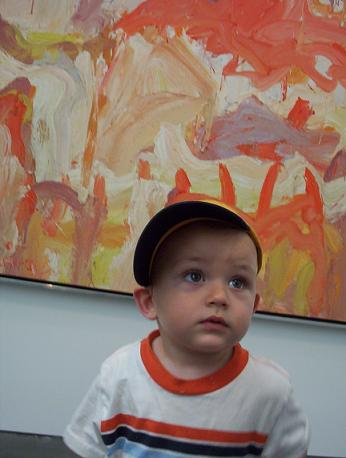


It can often be difficult, if not impossible, to explain or describe just why art is so important to me.

In the end, of course, it can't be done. It either works for you, or doesn't. It either speaks to you or it doesn't. Art education can help, and I support it wholeheartedly. But the risk is the loss of direct communication: if I have an art education, and this piece of art I'm looking at right now is saying nothing to me, and if it's a piece of art by someone who is well respected, then something must be wrong with me.

Art shouldn't be like that.

So everyone should have a Sam with them, because Sam makes art always new.

Why's that? you ask...

As my loved ones have heard me decry, ad nauseum, I find the practice of reading the wall-label before looking at a work of art particularly sad. It's as though the viewer needs to be told whether s/he should appreciate whatever s/he is looking at. Oh, this is Van Gogh, the viewer says, so I guess I better be impressed. Contemporary art really flummoxes wall-label readers: Oh my, what is this crap, it's nothing like in my schoolbooks, quick, look at the label, see what it's supposed to be about, see how I should be responding to this work....

But Sam doesn't give a spit.

Something either speaks to him, or doesn't.

My art-education-goal for Sam is that he never lose the sense of awe he has for new sights and sounds and smells and tastes. That he continue to explore wherever these new sensuous wonders take him.

With age, and experience, will come an increasing sophistication, and discrimination. But for now, Sam finds the entire world a wondrous invention, completely created for his own discovery.

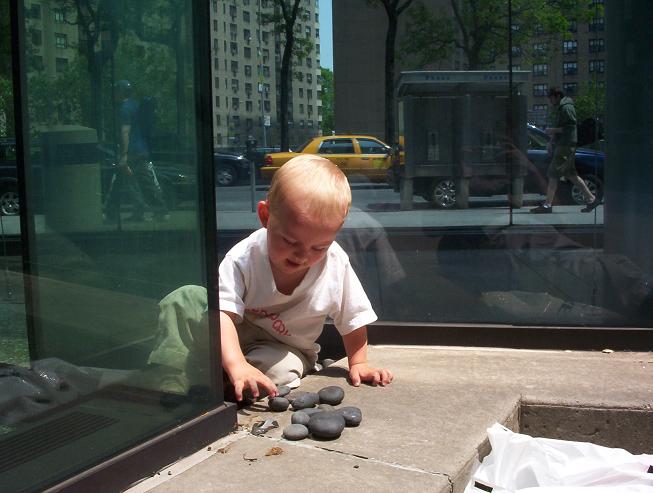
Whether he has come across stones from what must be New York City's smallest rock garden, (a 2' by 1' plot stuck in a weird corner between two slabs of skyscraper glass),

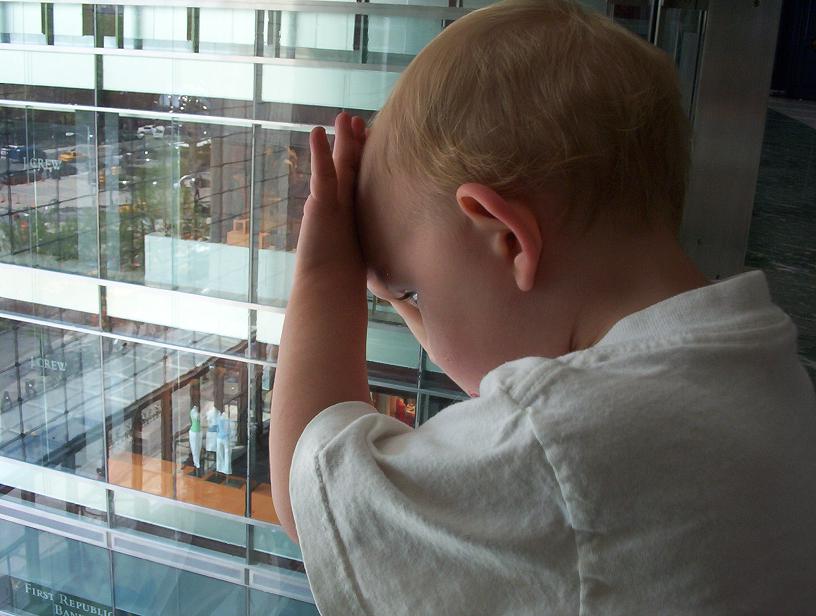
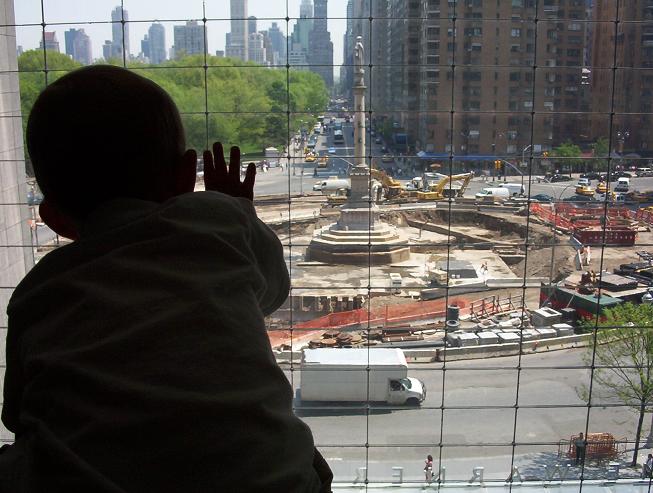
or has a first look at the view of Columbus Circle and Central Park from the new Time Warner Center,

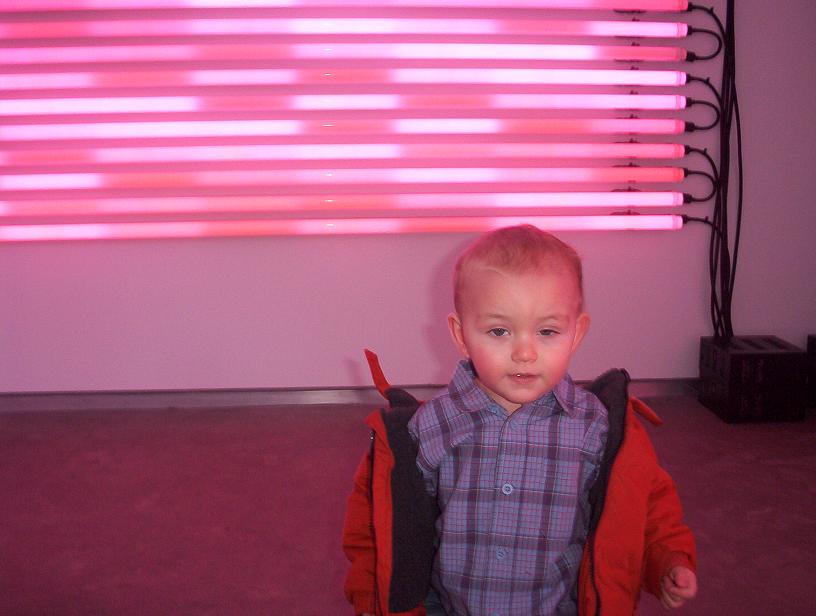
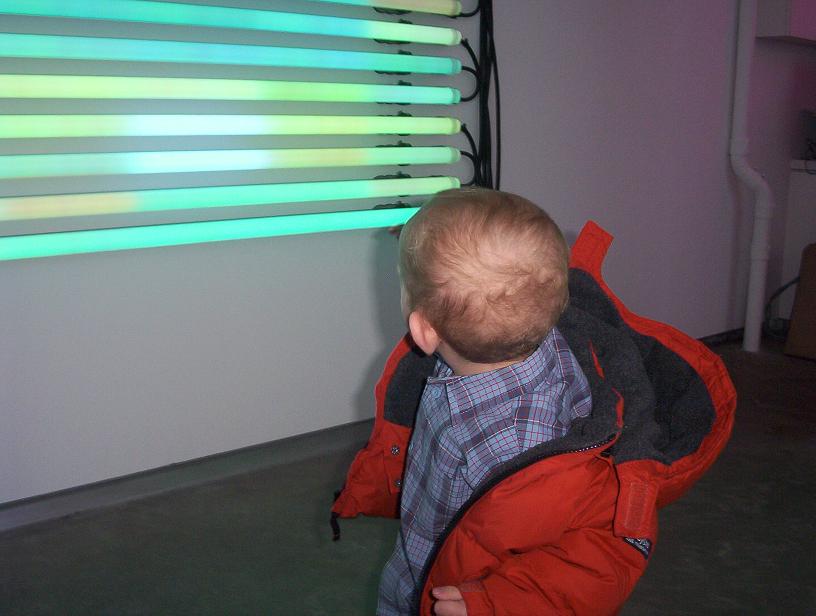
or encounters the work of a sculptor of light,

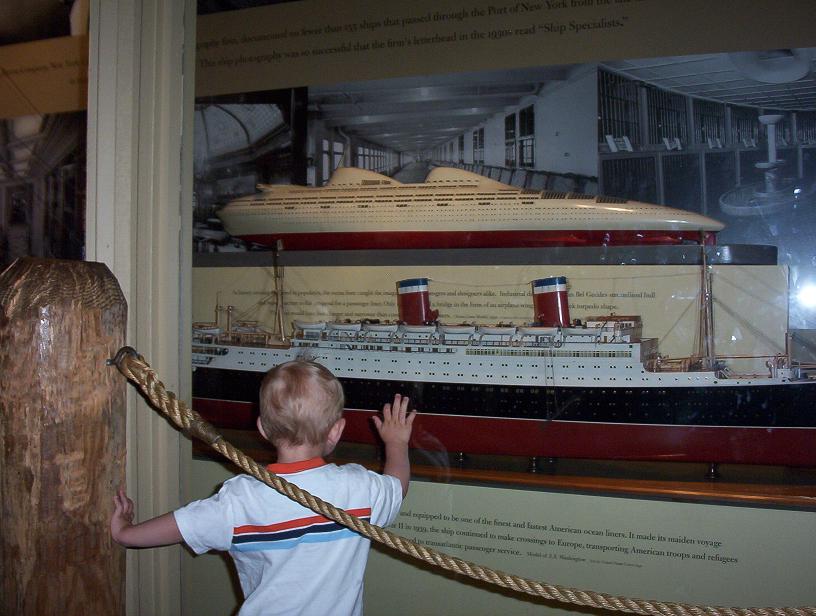
or begins to comprehend the beauty of great ship design,

Sam is a damned good teacher for potentially art-jaded folks like me. Put quite simply, he reinforces the value of looking. And great art rewards looking.

He's also a damned good excuse for a once-a-week retiree like myself to indulge in pleasure....



Our most recent Friday adventure took in two stunningly good exhibitions.

The first was a William DeKooning show at the Gagosian. Now, what little I'd seen of this guy left me singularly unimpressed and a bit creeped-out. Lots of pictures of grotesque figures, mostly
women. So that made the luscious paintings on view in this show all the more revelatory.

And then it was off to see the works of Michal Rovner, an Israeli artist who works with stone. These were something. The New York Times called her work "shimmering archeology." Hard to describe. Big pieces of stone, as from an ancient dig, with hieroglyphics on them. Except that when you look closely at them, the hieroglyphics move. You realize that they have video images of tiny moving people projected onto them.

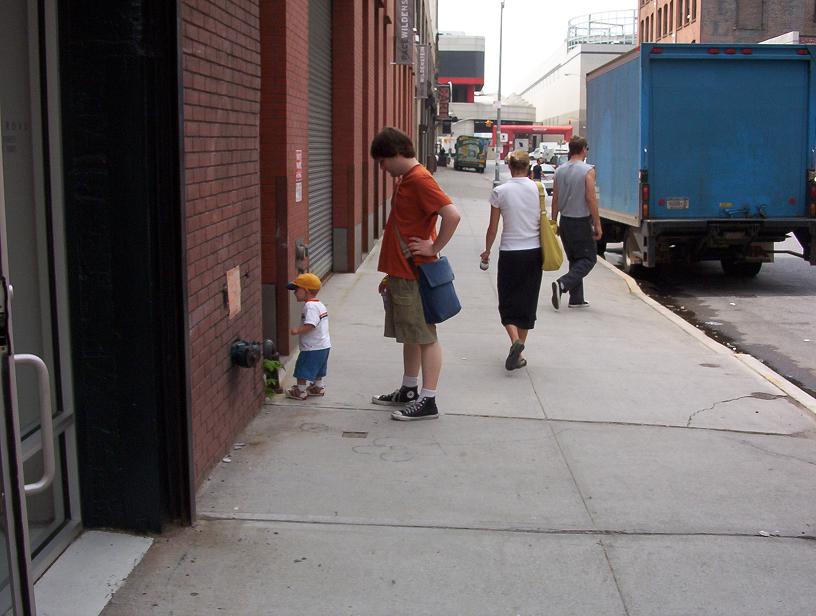
Sam's Uncle John joined him on this outing:
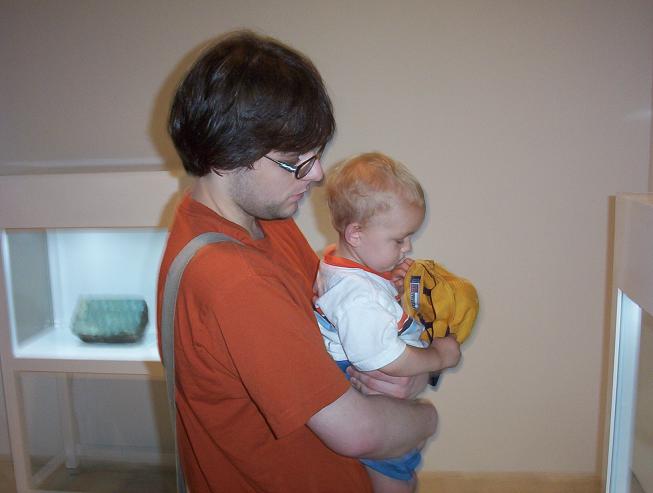

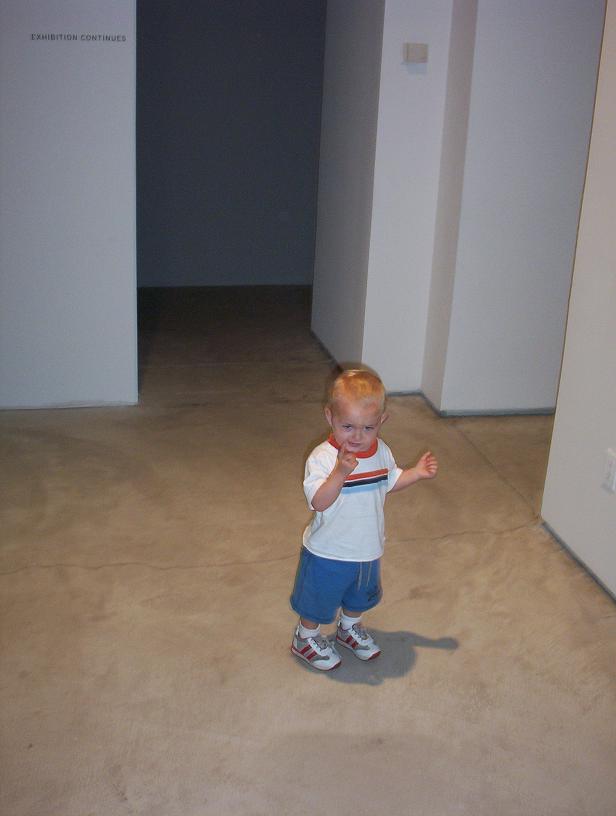
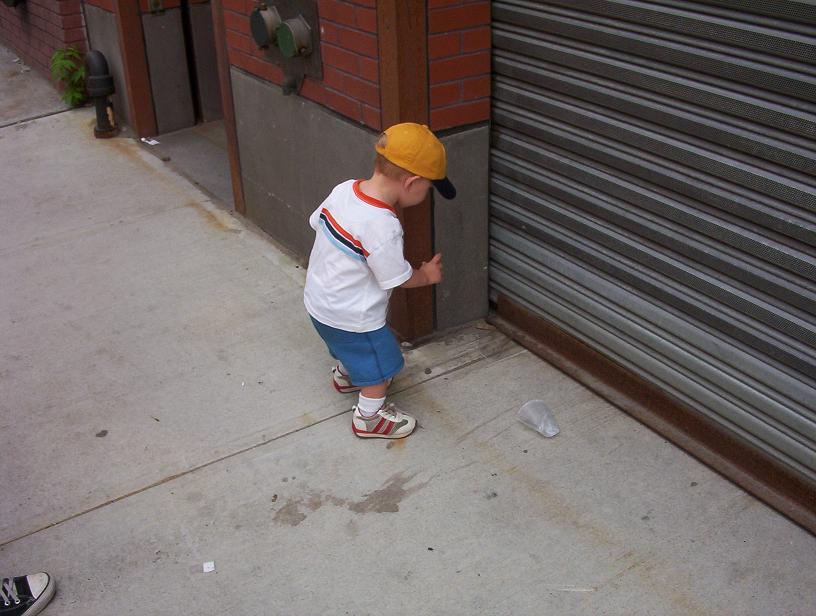
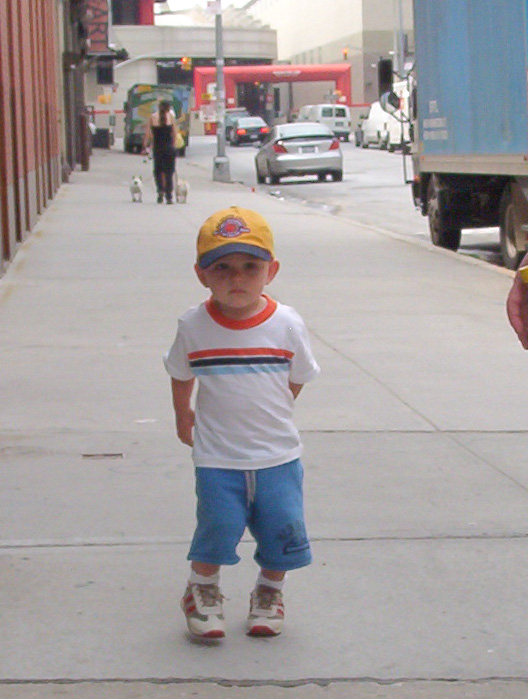
The room Sam is beckoning you into, in this photo, was both dark and mysterious. Sam initially had no interest. But curiousity got the better of him and he went in, and up a long ramp (which he ended up running up and down) to a viewing area overlooking a big dirt pit, with huge stone tablets, Ten Commandments' size, lying open on the ground. And small dancing figures in even lines covering the surface. You gotta see these things...

One of my personal truisms regarding a good art visit is that, afterwards, the world looks different. More interesting somehow. Sam definitely agrees: here is is fascinated with who knows what? I had no idea what had so grabbed his attention. Neither did John. Whatever it was, Sam knew how to deflect questions about his sanity: look cool, and don't mess with me.

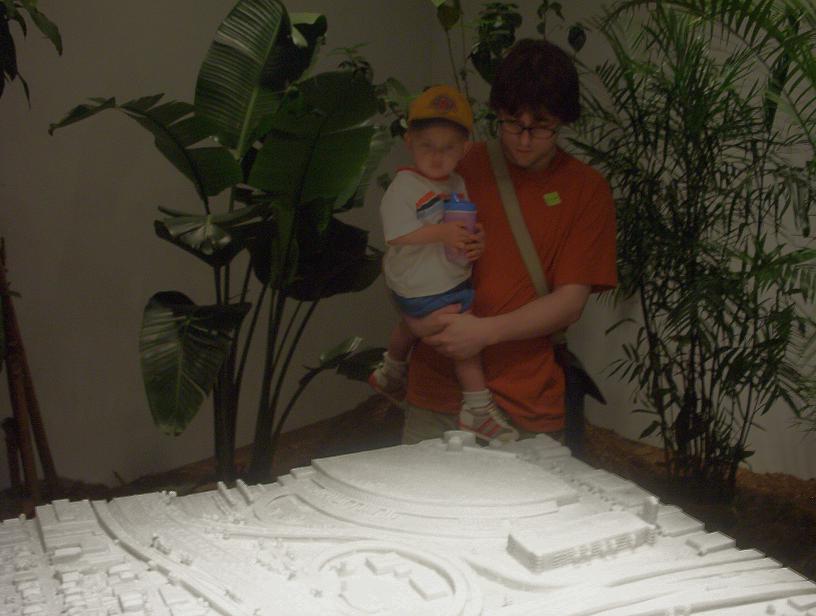
Finally, Sam brought John to the Whitney for a final look before the biennial ends. Here they are both examining the layout of an imaginary town carved in marble. Don't ask.

John passes on some wisdom:
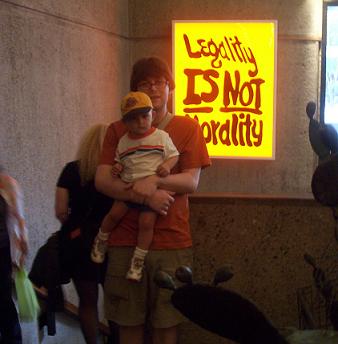

Then it was jump in a cab to meet Sonja and head home.

Bye!


..

Saturday, May 15, 2004

....

THE JOYS OF SERIOUS PLAY


Mary, Sam's grandma, recently conducted a workshop entitled "Doing & Discovering: The vital role of play, in living, loving and learning." The audience was teachers and administrators from Early Head Start programs (a program for low income children from birth to age three) across New York State. Mary is an infant-toddler specialist, particularly as it relates to children with disabilities, and she often makes conference presentations. Lately she's been using Sam. A lot.

For this workshop she used a series of photos that I, Sam's grandpa, took of Sam watering our plants. The purpose was to demonstrate visually how an infant/toddler learns new skills.

So here's the set up.

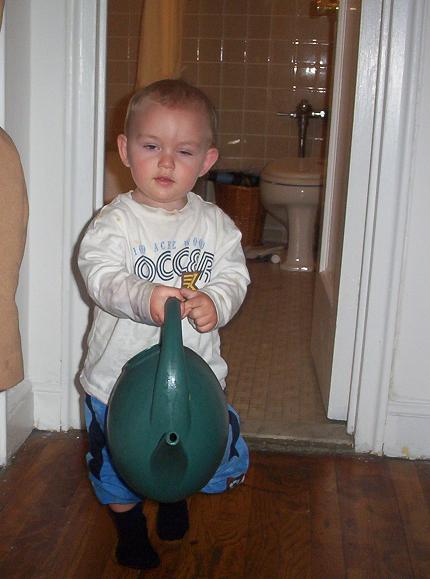
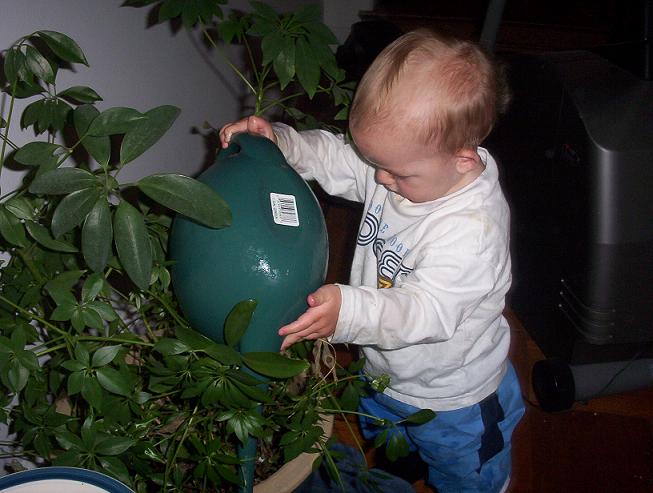
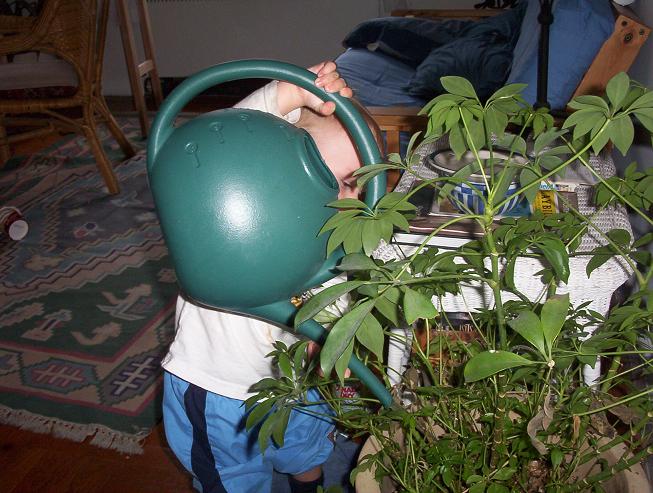
Sam wanted to water the plants. Insisted on it. Previously he had always used his child-sized watering container. But recently he learned the concept, and the word, "big." So for the first time he insisted on using Grandma's big watering container. Thereby setting new challenges for himself.

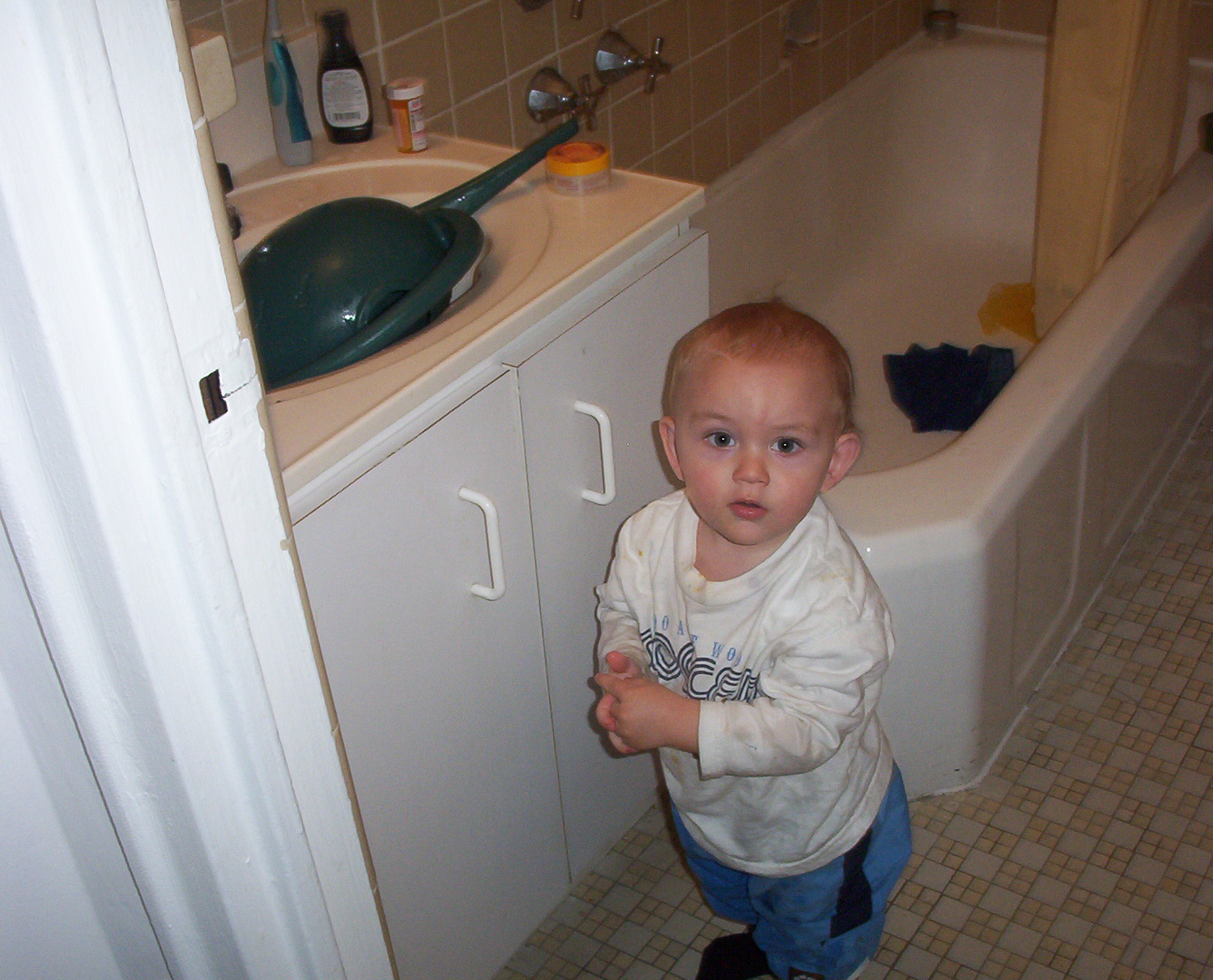
He got the watering container, and first needed to fill it with water. He kept pointing at the sink until I got the message and put it in the sink for him.

This is where our story begins. Sam needed to solve this problem through trial and error.

It was clear that the sink option wasn't going to work.

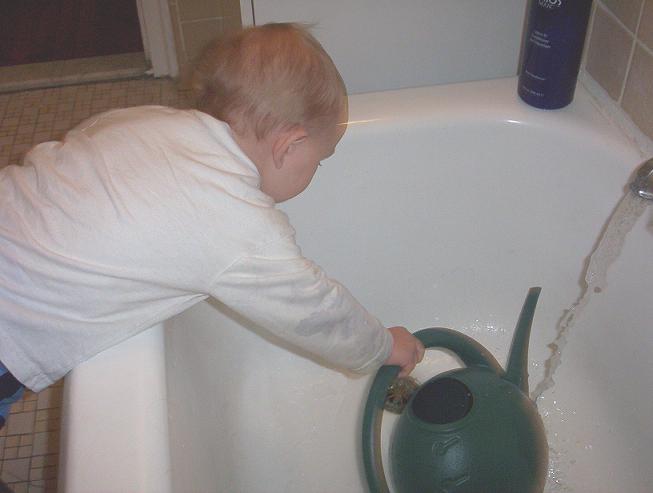
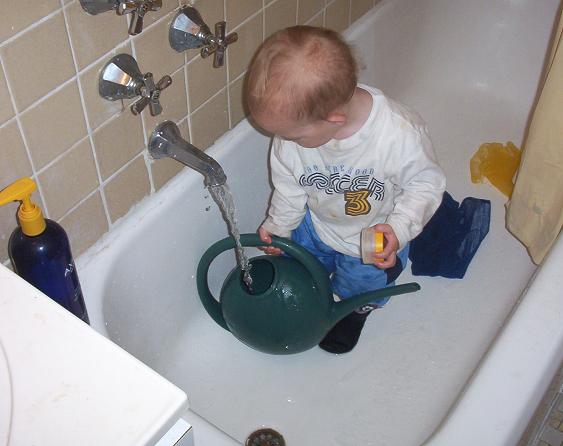
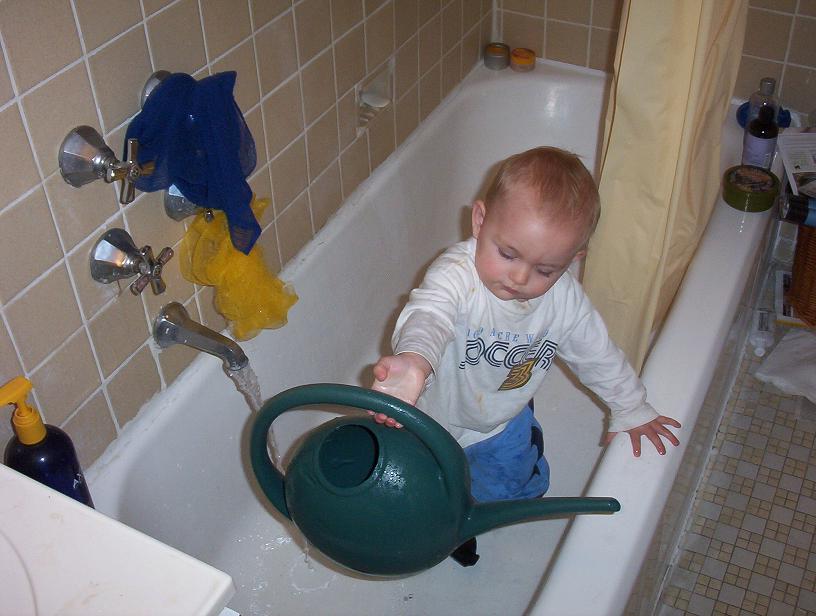
But there was another option. I obligingly turned on the water for him. His job was to fill the container. A bit difficult.

So he only had one viable option. Messy but effective.

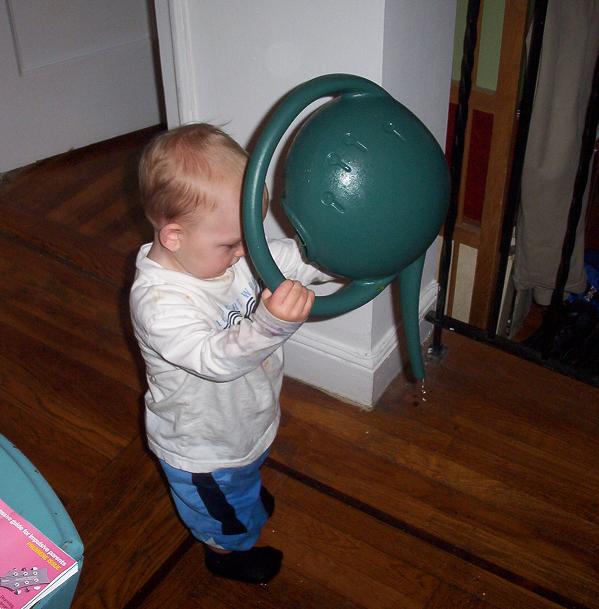
Now that it was filled, he carried it into the hallway. Because he had filled it so high, he was gaining a firsthand understand of the concept of 'heavy'.

"Oh, gee, what happens if I turn it this way? Wow, look at that."

Then the realization dawns: "I've got a problem. No more water in the container."

So back to the source. Still messy, still effective.

Success!

Uh, oh, look a bit closer at where the spout is going.

Missed again.

So he repeats the whole process, and this time really does succeed.

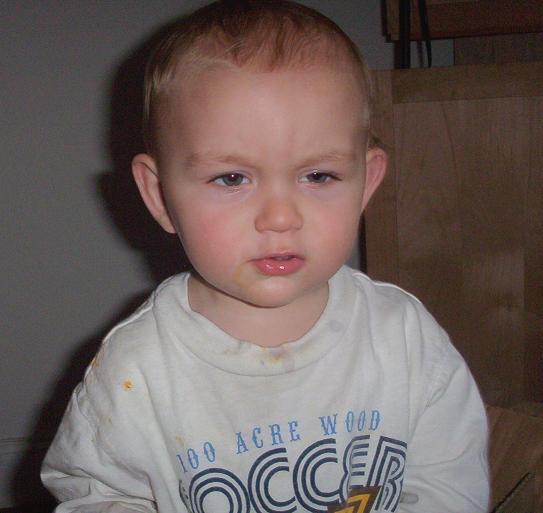
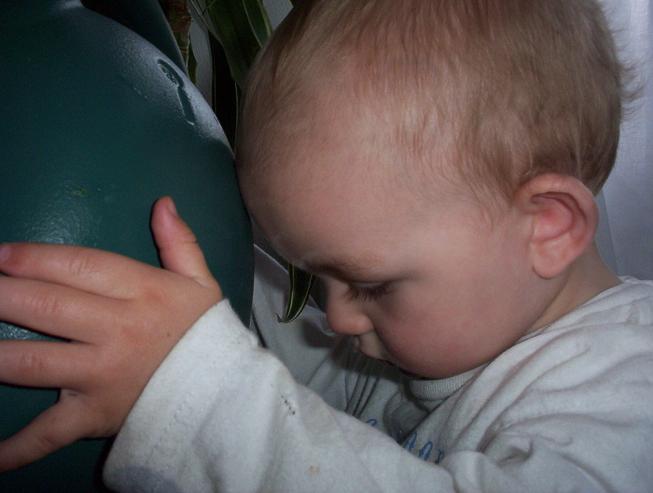
And this photo shows the intensity of his concentration after successfully meeting the challenge. As Mary pointed out to the conference participants: "note that he doesn't look out to the world for acclaim, or congratulations, or otherwise outwordly show happiness in his success. The joy here is intrinsic. He has no desire for external rewards. The joy comes from the process of doing. And discovering."


Saturday, May 01, 2004

.....


.......................................England Shoots. Scores!!....................................

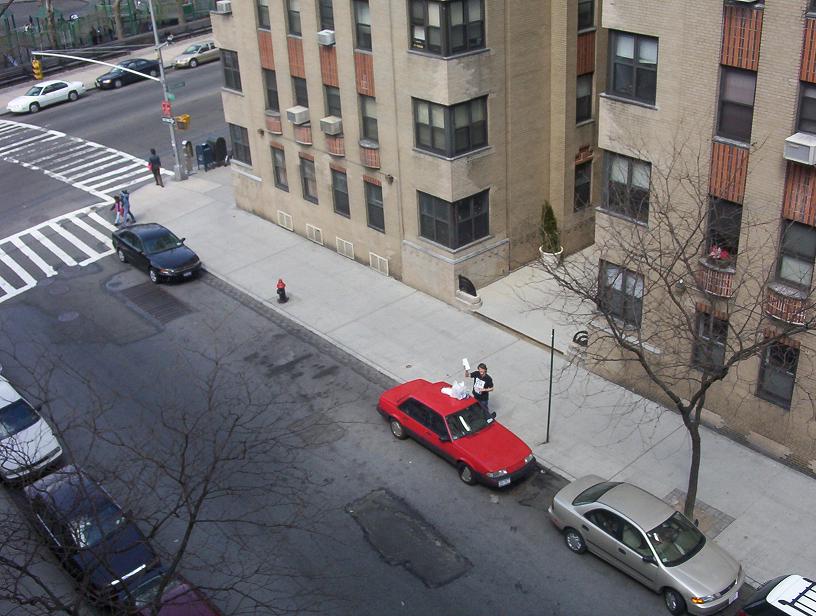
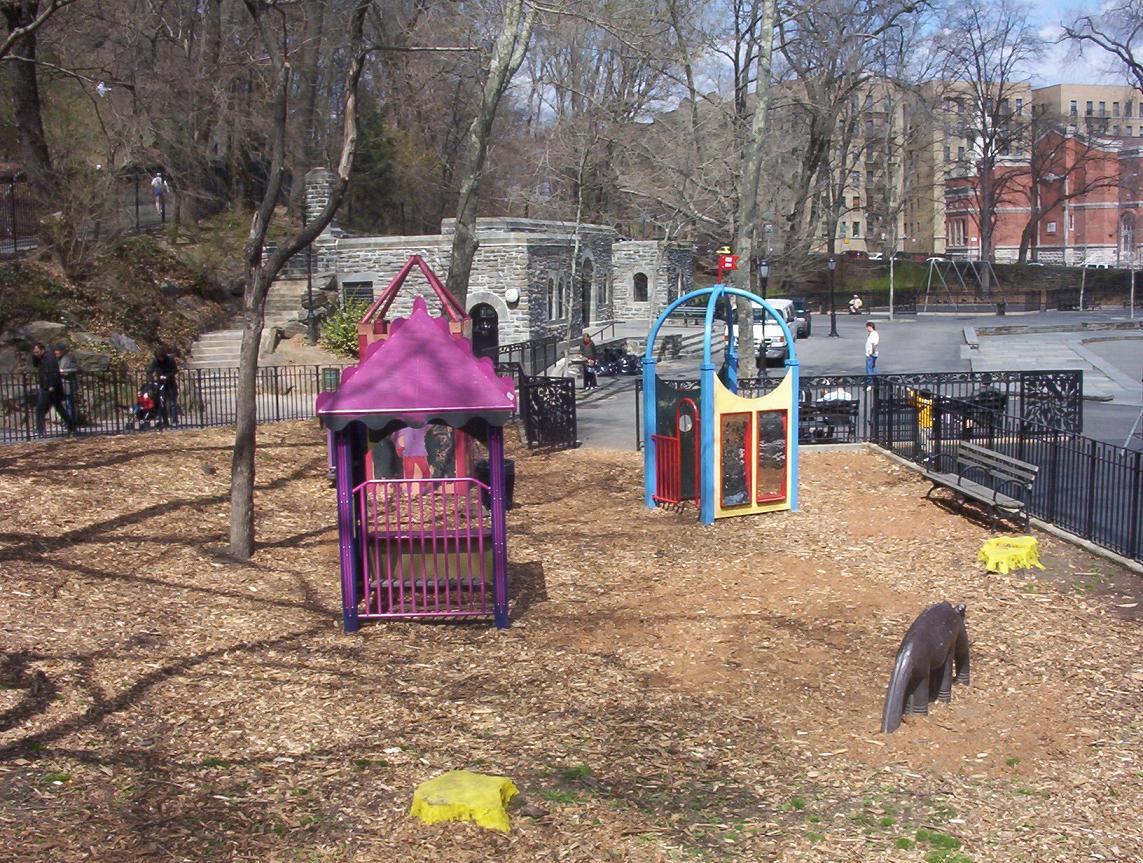
Sam spends a good hour or two or three or four every day at Dykeman Playground, across Broadway from his apartment (you can see a glimpse of it from Grandpa's apartment window- check the upper left corner of this photo of Paul waving while cleaning the car). It is at the northeast corner of Fort Tryon Park.

Fort Tryon Park, which includes the Metropolitan Museum's medieval art collection at The Cloisters, lies north of the George Washington Bridge, and is mostly situated along the top of a rocky ridge, with steep and gorgeous views of the Hudson River. It opened in 1935, built mostly with Rockefeller money. Built during the great Depression, this is what the Federal Writer's Project (a Roosevelt-funded program for unemployed writers), said:

"Fort Tryon Park is one of the most beautiful public parks of America -- landscaped with trees, lawns, terraces, rock gardens, paved walks, and many benches, all cleverly ordered in harmonious composition. The precision of its design is explicitly urban. The views from its heights are perhaps the finest Manhattan offers, for they sweep mile after mile of the Hudson and the Palisades, and, to the east, range across the lowlands of Inwood. At the sourthern entrance to the park, near Fort Washington Aveune, a large sloping rock garden forms an approach to the stone ramparts marking the site of old Fort Tryon, built in the summer of 1776 and taken in the fall of the same year by the Hessians. The landscaping was done, appropriately, by Frederick Law Olmsted, son of the proposer of the park plan for Inwood.

The Park's sixty-two acres include the grounds of the former C. K. G. Billings estate. John D. Rockefeller, Jr., bought the property in 1909 for $1,700,000, gave it to the city in 1930, and spent $3,600,000 improving it. The gift was in accordance with an agreement between Mr. Rockefeller and the city whereby the eastern ends of Sixty-fourth and Sixty-eighth Streets were closed and conveyed to Rockefeller Institute."


By the way, Rockefeller was so intent that the views from these cliffs overlooking the Hudson remain spectacular that he bought all the land on the other side of the Hudson, and preserved it.

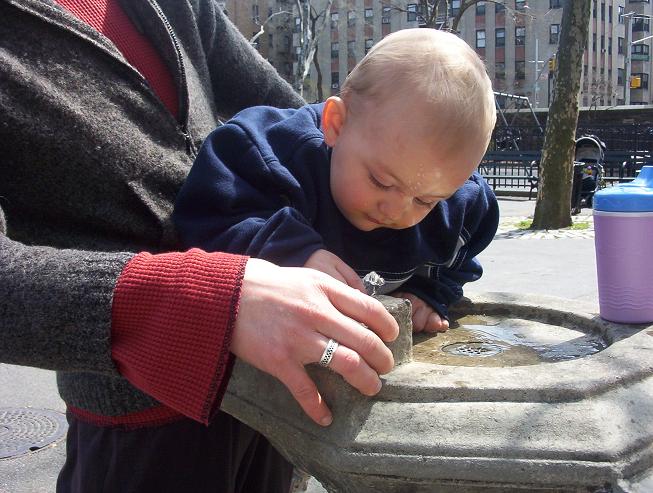
But hey, what does Sam care? He just knows it's a fun place to play. If you look real closely you can see Sam and Mom at the drinking fountain at the south end of the playground, and Dad a bit off to the right.

Let's move in a little closer. That better?

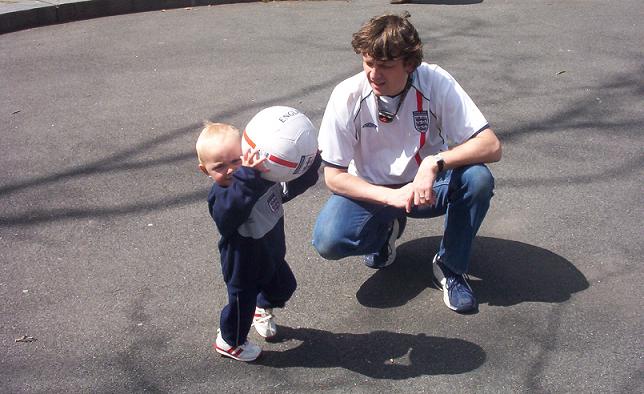
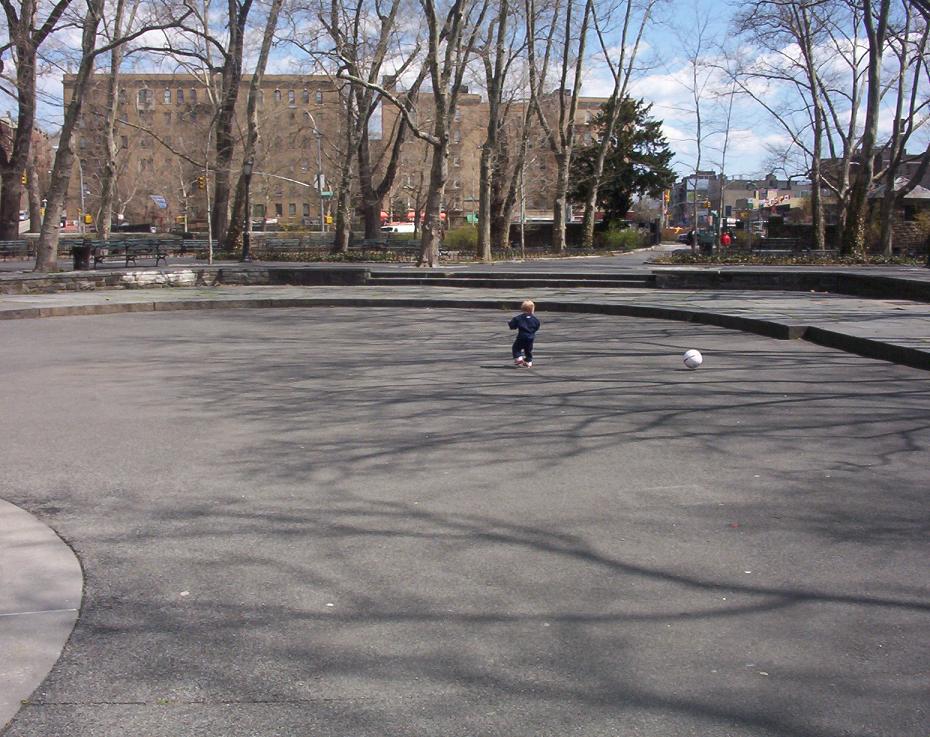
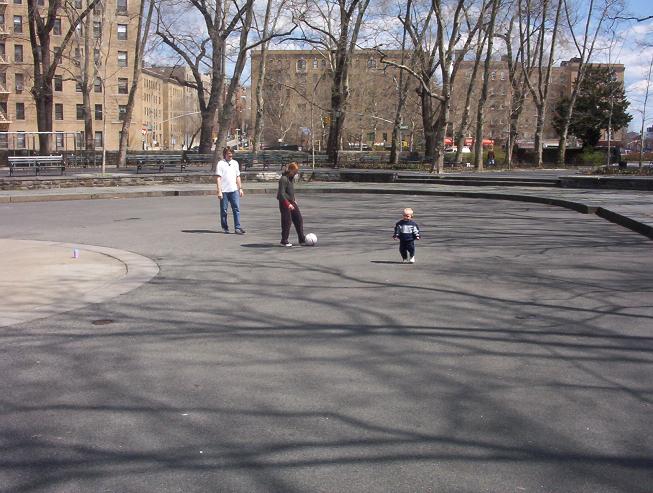
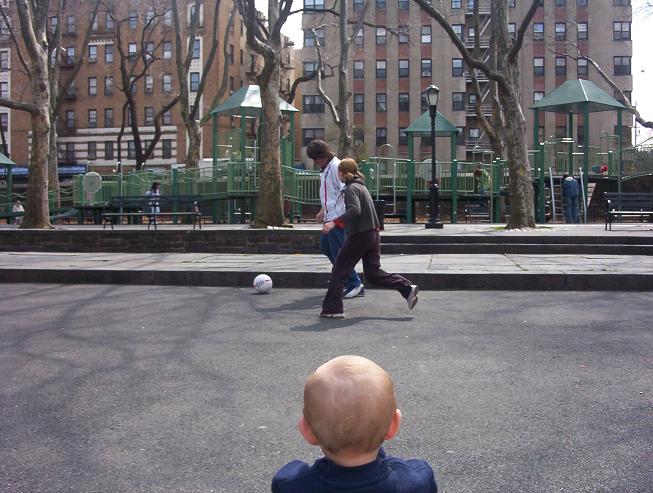
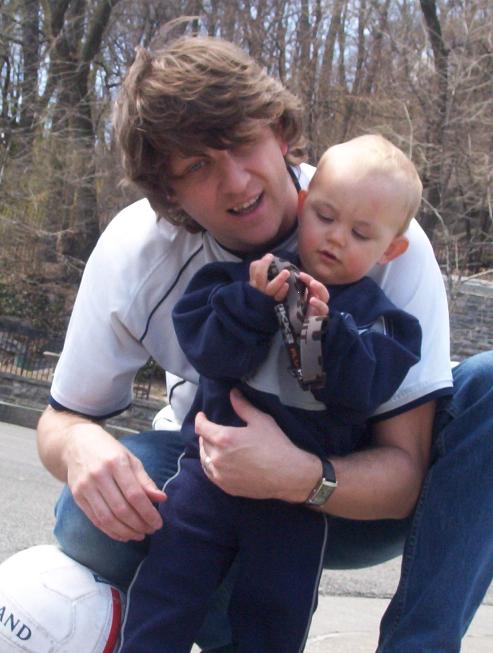
On this particular day, Sam and Dad came out in full England regalia (including the ball). Sam had a lot of choices. He could strike out on his own with the ball, getting a bit lost in the vastness of that part of the playground, or team up with his parents, or simply watch them go at it without him.

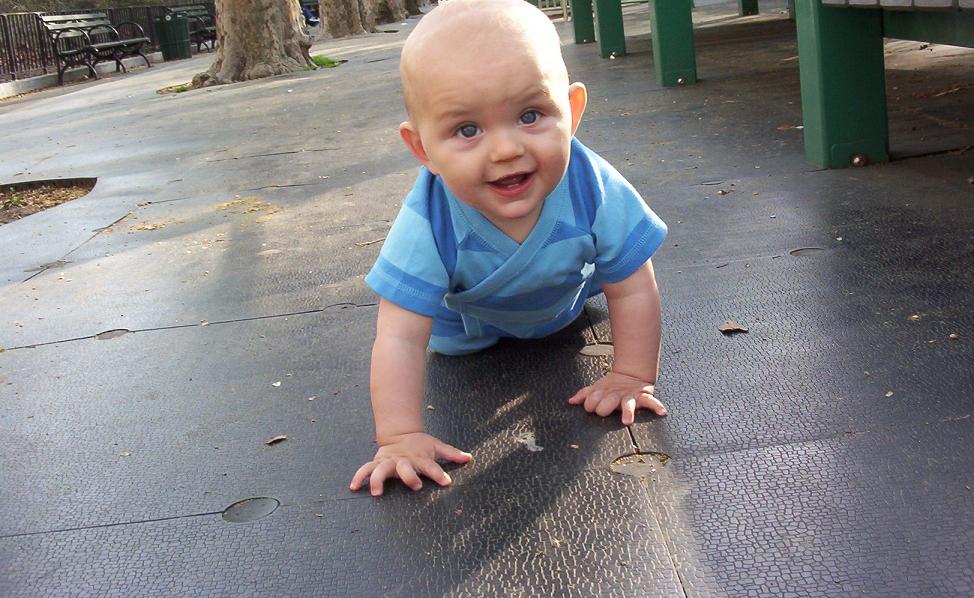
(note: in the background of that last photo, note the green playground equipment. It is on the ground next to this equipment that, a bit more than a year ago, Sam first started to crawl)

It's a good playground, in an amazing park (Sam will be giving youngsamwise fans a tour sometime soon we hope).

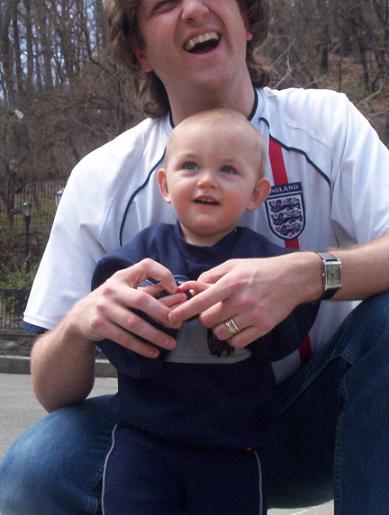
Time for one last great peek at Sam and his Dad:


Oh hell, I can't resist one more.